Where Does the .4 Number Come From for Fts in Basketball Analytics
By John Ezekowitz
Effective Field Goal Percentage. Turnover Percentage. Offensive Rebounding Rate. Free Throw Rate.
Ever since Dean Oliver posited these statistics as the most important for explaining how teams score and defend in basketball, these so-called Four Factors have been the gospel of the tempo-free college basketball stats community. According to Oliver, the Four Factors are listed in order of their relative importance, with Free Throw Rate being the least important of the four. FT Rate, Free Throws Attempted divided by Field Goals Attempted, measures how often a team gets to the line. Oliver was very insistent on this definition, saying, "the biggest aspect of 'free throws' is actually attempting them, not making them. Teams that get to the line more are more effective than teams that make a higher percentage of their free throws…"
This has always struck me as odd. Sure, getting to the line is very important (it leads to all sorts of beneficial effects of getting the other team in foul trouble), but free throw makes matter, too. Could there be a statistic that better measures both? Now, with seven full years of college basketball data at hand, we have a dataset big enough to investigate the question. And the answers are surprising. It's time to re-evaluate that Fourth Factor.
Two weeks ago, I unveiled a new metric I called Free Throw Plus. The full methodology is detailed here, but the more I thought about it, the more one of the inputs really interested me. To calculate FT+, I needed first to calculate Free Throws Made per 100 Possessions, or as I call it, FTM/Poss. FTM/Poss is an interesting stat because it takes made free throws into account in a tempo-free manner. Just like Turnover Percentage, FTM/Poss takes a useful counting stat and makes it better by controlling for the pace at which teams play. My friends at Team Rankings have calculated the FTM/Poss standings for 2011 here.
But is it a better stat than Free Throw Rate? To answer this, I first had to specify some criteria. First, I decided to look at offense only. The role that the free throw line plays in defense is much more complicated — while a team can control its own free throw shooting, it can do little (other than fouling big men who shoot worse from the line) to control that of its opponents. The defensive implications of FTM/Poss will be tackled in another post.
To analyze the relative merits of the two stats, we should start with whether FT Rate or FTM/Poss is a better predictor of offensive efficiency. Oliver defines his Four Factors as the components that make up offensive and defensive efficiency. Oliver's pioneering offensive and defensive ratings, which measure points scored and allowed per 100 possessions (or points per possession, if you prefer), were the measures of efficiency. If one of the two stats is clearly superior in predicting offensive efficiency, that has large importance in Oliver's framework. Additionally, it is important to look at how well these two stats measure getting to the free throw line.
On the first count, the answer is clear. Using team data compiled from Ken Pomeroy and Statsheet.com for all teams from 2004-2010, I ran a series of regressions controlling for the other three offensive factors and defensive efficiency. The results are below:
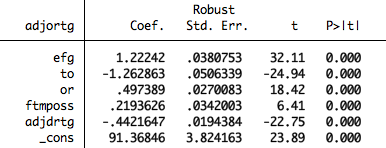
This regression used FTM/Poss instead of FTRate. The Adjusted R^2 was .8179, and the root mean square error (variance of the error, a lower number represents a better fit) was 3.826.
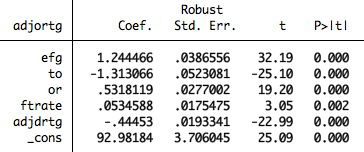
This regression used FT Rate. The Adjusted R^2 was .7912, and the RMSE was 3.992.
As you can see, while both are significant predictors of Adjusted Offensive Efficiency, FTM/Poss is a slightly better predictor than FT Rate. The difference is not huge, but it is still apparent. Including both FT Rate and FTM/Poss in a single regression shows that both are significant predictors, but that FTM/Poss has a higher t statistic (5.55 to -4.43). Thus in terms of predicting offensive efficiency, FTM/Poss appears to be a better choice for the Fourth Factor.
But, of course, there is more than just predicting offensive efficiency. We need to know how often teams get to the free throw line. As you might expect, the two metrics are highly collinear, with a correlation of 85 percent. But what of the 15 percent variance? Is FTM/Poss missing some important measure of how many times a team gets to the line? Theoretically, and as we observe in the data, FTM/Poss should increase as FT Rate increases: more chances will lead to more makes. So where is the variance? Take a look at this scatter plot of FTM/Poss and FT Rate for the 2010 season.
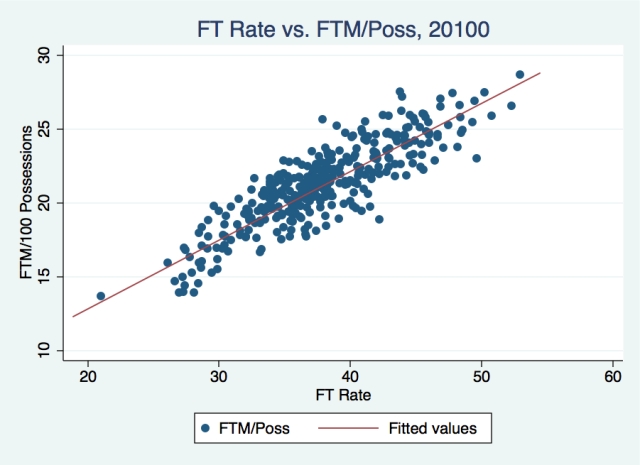
Unfortunately, the data was packed too tightly to get coherent team labels into the graph. Nevertheless, we can examine the nature of the variance by looking at teams (datapoints) that are relatively far away from the best fit line.
First, a team that has a relatively high FT Rate, and a relatively low FTM/Poss. In 2010, Northwestern State of the Southland Conference had an FT Rate of 49.63, getting a free throw attempt for every two of their shots. Kansas State had an almost identical FT Rate of 49.86 percent. Yet while Kansas State scored 27 Free Throws per 100 possessions, putting them right on the best fit line, NW State scored only 23 FTs per 100 possessions. That is a four-point difference in offensive ratings over every 100 possessions, holding all other things equal. This is an example of a comparison that FT Rate misses (it views Kansas State's and Northwestern State's free throw performance as identical), but FTM/Poss gives better information on.
How about a case where FTM/Poss views two teams as identical, but there is a difference in FT Rate? For this, we can compare two teams from 2010: the national champion Duke Blue Devils, and the Oakland Golden Grizzlies. Both Duke and Oakland made 25.6 Free Throws per 100 possessions in 2010, yet Oakland had an FT Rate of 41 percent, whereas Duke's FT Rate was 37 percent. A 4 percent difference might seem like something significant, but as it turns out, it really is not. In fact, the Blue Devils actually drew more fouls per game and per 100 possessions than the Golden Grizzlies, but come out with a lower FT Rate because they simply took more shots. This was probably a function of Duke having a lower Turnover Rate and a higher Offensive Rebound % than Oakland.
So which variance explains more of a team's offensive success: a case where FTM/Poss identifies an extra four points per 100 possessions that FT Rate does not see, or the case where FT Rate finds that a team gets to the line more often simply because they took fewer shots? I actually did not cherry-pick these examples: I just chose two data points that were relatively far away from the best fit line where FT Rate = FTM/Poss to examine. I think both examples, and the correlation between the two statistics, show that FTM/Poss captures almost all of the "getting to the line" effects that FT Rate measures, while also measuring how much teams actually score once they get there.
The positive effects of getting to the line, and thus getting your opponent in foul trouble, should also extend to defense for two reasons: foul trouble causes coaches to sit their starters and put in reserves, and because teams (even bad free throw shooting teams) score more effectively from the line, it allows them on average to build leads and causing the opponents to play from behind. We can (admittedly crudely) test the ability of FT Rate and FTM/Poss to measure the "getting to the line" effect by looking at how well they predict defensive efficiency. As it turns out, when controlling for the defensive Four Factors and overall offensive ability, FTM/Poss is again just as good a predictor of defensive efficiency (t stat= 6.20, p<0.001) than FT Rate (t stat=3.20, p<0.001).
After weighing all of this evidence, it seems hard to conclude that Free Throw Rate is a better offensive Four Factor than FTM/Poss. FTM/Poss is a better predictor of offensive efficiency, and also seems to capture the effects of getting to the line well. Theoretically, the best single free throw stat would be able to show not only how many points a team gets from going to the line, but also indicate some of the second-order effects that come from getting the other team in foul trouble. FTM/Poss fits that description far more closely than Free Throw Rate.
While this analysis may not be a decisive and thorough victory for FTM/Poss, I think it certainly provides a strong case for revamping the Fourth Factor. Now if only we could come up with a snappier name for Free Throws Made per 100 Possessions…
Where Does the .4 Number Come From for Fts in Basketball Analytics
Source: https://harvardsportsanalysis.wordpress.com/2011/02/21/re-examining-the-four-factors-the-case-for-free-throws-made-per-100-possessions/
0 Response to "Where Does the .4 Number Come From for Fts in Basketball Analytics"
ارسال یک نظر